
Rhabdopleura belongs to the class Pterobranchia and represents one of the simplest living hemichordates.
It lives in colonies on hard marine substrates and secretes delicate tubes, called coenecia, in which individual zooids reside.
Each zooid extends its tentaculated arms to filter feed, capturing suspended particles from the surrounding water. Because it shares important features with ancient graptolites, Rhabdopleura helps scientists understand early deuterostome evolution and the origins of chordate traits.
For Practical Study
The following notes are arranged in a practical examination format for easy study and identification.
Classification of Rhabdopleura
| Rank | Classification | Characteristic |
|---|---|---|
| Kingdom | Animalia | Multicellular animals |
| Phylum | Hemichordata | Marine deuterostomes with a characteristic proboscis, collar and trunk |
| Class | Pterobranchia | Small, tube-dwelling hemichordates, commonly colonial |
| Order | Rhabdopleurida | Rhabdopleurid pterobranchs |
| Family | Rhabdopleuridae | Family containing Rhabdopleura |
| Genus | Rhabdopleura | Colonial pterobranchs living in secreted tubes |
Geographical Distribution
Rhabdopleura is a marine genus with species recorded from different oceanic regions. Individual species may occur in shallow or deeper marine environments, often associated with suitable hard substrates.
Habit and Habitat
Rhabdopleura is a colonial marine hemichordate. Its zooids live within delicate tubes secreted by the colony and are commonly attached to shells or other hard substrates. The zooids use their tentacular feeding structures to collect suspended food particles from seawater.
Comments
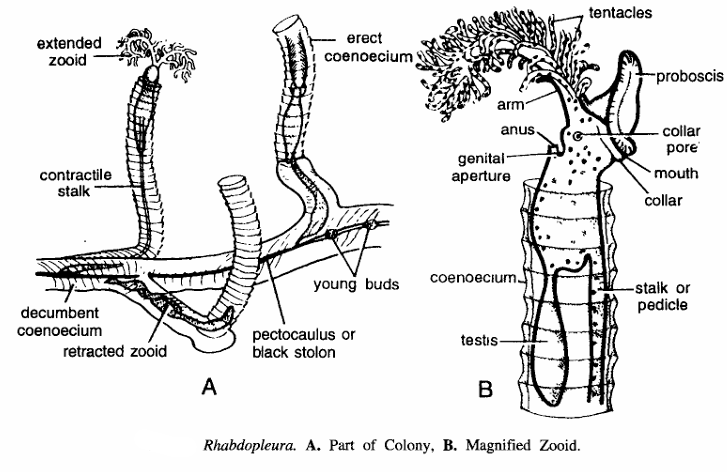
- Colony consists of zooids enclosed into erect tubes which are much more elongated than zooids.
- Colony contains erect coenoecium extended zooids, contractile stalk, decumbent coenoecium, retracted zooids, pectocaulus and young buds.
- Each zooid is composed of stalk, trunk sac, oral lamella, pigment stripe, cephalic shield, arms and tentacles.
- There is a lophophore with one pair of arms, one gonad, but without gill-slits. Alimentary canal is V-shaped.
- Most of the zooids are sterile, but male and female specimens may be observe.
- Sexes united.
- Development includes a free-swimming larva.
- Zooids are formed by budding, but the buds do not break off from the stolon and remain permanently attached to form a colony.
Special Features
This colonial hemichordate forms organically connected individuals, and each new individual develops through sexual budding from an existing one.
Identification
Rhabdopleura is identified by its colonial marine habit, small zooids enclosed in secreted tubes, stolon connections and characteristic tentacular feeding structures, which distinguish it from solitary enteropneust acorn worms.
Quick Identification of Rhabdopleura
| Feature | Description |
|---|---|
| Common name | Rhabdopleurid pterobranch |
| Scientific name | Rhabdopleura |
| Phylum | Hemichordata |
| Class | Pterobranchia |
| Order | Rhabdopleurida |
| Family | Rhabdopleuridae |
| Habitat | Marine |
| Body form | Small, soft-bodied zooids living within secreted tubes |
| Colony | Usually colonial, with zooids connected through a stolon system |
| Feeding | Filter feeding using tentacular feeding structures |
| Digestive tract | U-shaped |
| Gill slits | Absent |
| Key identifying feature | Colonial zooids enclosed in tubes |
| Special significance | Living pterobranch associated with the graptolite lineage |
Physical Characteristics of Rhabdopleura
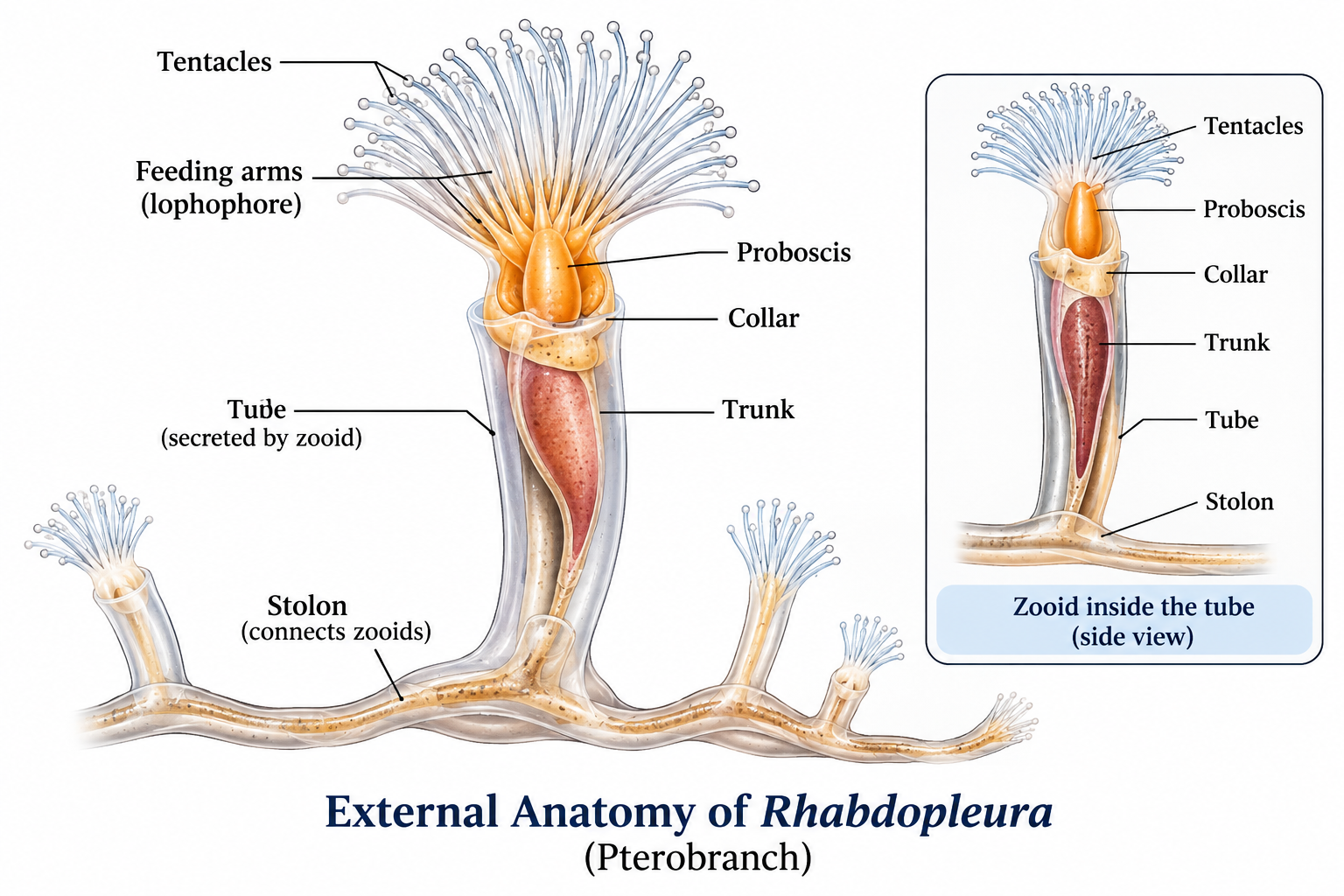
Rhabdopleura has a highly specialized body adapted to a small, colonial and tube-dwelling lifestyle. Unlike the elongated, free-living body of acorn worms, each pterobranch zooid is small and remains associated with a protective tube within the colony.
Main Physical Features
- Body regions: Each zooid retains the basic hemichordate organization of proboscis, collar and trunk.
- Proboscis: The shield-shaped proboscis helps the zooid secrete material that forms the protective tube, or coenecium.
- Collar: The collar bears the characteristic feeding structures with ciliated arms and numerous tentacles.
- Trunk: The trunk contains the major internal organs and connects with the posterior part of the zooid.
- Colonial organization: Numerous zooids form a colony and are connected through stalks or a stolon system.
- Protective tubes: Zooids live within tubes secreted by the colony, providing a protected environment for the animals.
- Digestive tract: The digestive system is characteristically U-shaped, unlike the through-gut of typical enteropneusts.
- Gill slits: Rhabdopleura lacks pharyngeal gill slits.
- Feeding structures: The ciliated tentacular arms create water currents and help capture suspended food particles.
- Body size: The zooids are very small and can easily be overlooked during marine sampling.
The combination of small zooids, secreted tubes, colonial organization and tentacular feeding structures makes Rhabdopleura distinctly different from solitary acorn worms such as Balanoglossus and Saccoglossus.
Feeding and Filter-Feeding Adaptations of Rhabdopleura
Rhabdopleura is adapted for suspension feeding in marine environments. Its feeding structures generate water currents and capture small suspended food particles from the surrounding seawater.
The collar bears a pair of ciliated arms carrying numerous delicate tentacles. Coordinated movement of the cilia produces currents that bring water and food particles toward the feeding region.
Major Feeding Adaptations
- Tentacular arms: Numerous tentacles increase the surface available for collecting suspended particles.
- Cilia: Ciliary movement creates water currents and helps transport captured particles toward the mouth.
- Mucus: Food particles can become trapped in mucus associated with the feeding structures.
- Selective particle capture: Small suspended organic particles and microorganisms can be collected from the water.
- U-shaped digestive tract: The arrangement of the digestive system allows food to pass through the digestive region while the mouth and anus remain relatively close together.
- Colonial lifestyle: Living in colonies allows many zooids to feed simultaneously within the same marine environment.
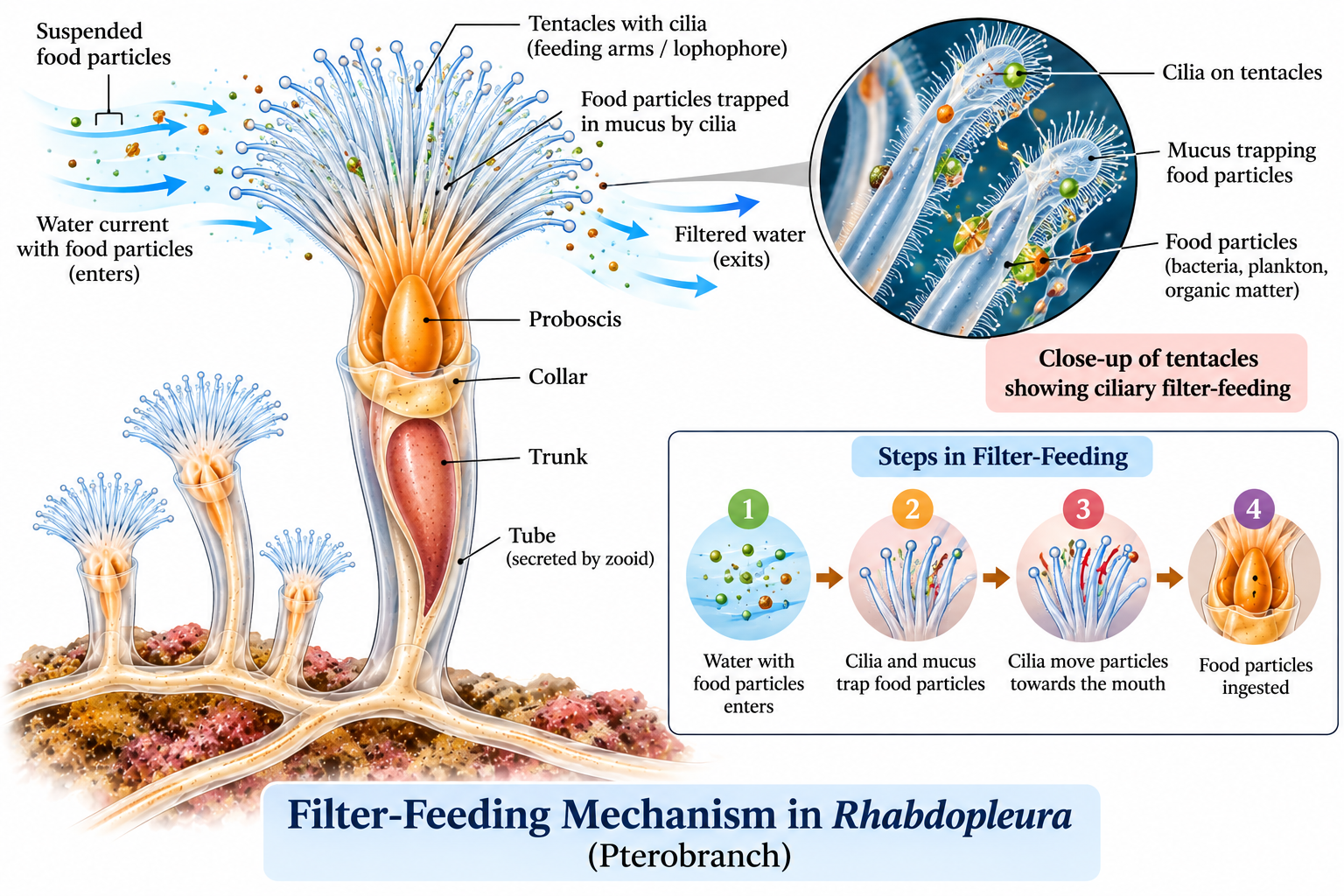
The feeding mechanism of Rhabdopleura reflects its adaptation to a sessile colonial existence, where the zooids remain associated with their tubes while obtaining food from moving seawater.
Colony Formation and Zooids in Rhabdopleura
One of the most distinctive features of Rhabdopleura is its colonial organization. Instead of living as an isolated individual, numerous small zooids occur together within a common colony.
The colony develops through the production and arrangement of zooids within a network of secreted tubes and stolons. Each zooid remains associated with its own protective tube while maintaining a connection with the rest of the colony.
Structure of the Colony
- Zooids: Individual feeding units of the colony.
- Tubes: Protective structures secreted by the colony in which the zooids live.
- Stolon: A connecting structure that links zooids within the colony.
- Feeding structures: Each zooid possesses tentacular arms used for suspension feeding.
- Budding: New zooids can be produced asexually, allowing the colony to increase in size.
- Colony growth: Repeated production and arrangement of zooids results in branching or other characteristic colony forms.
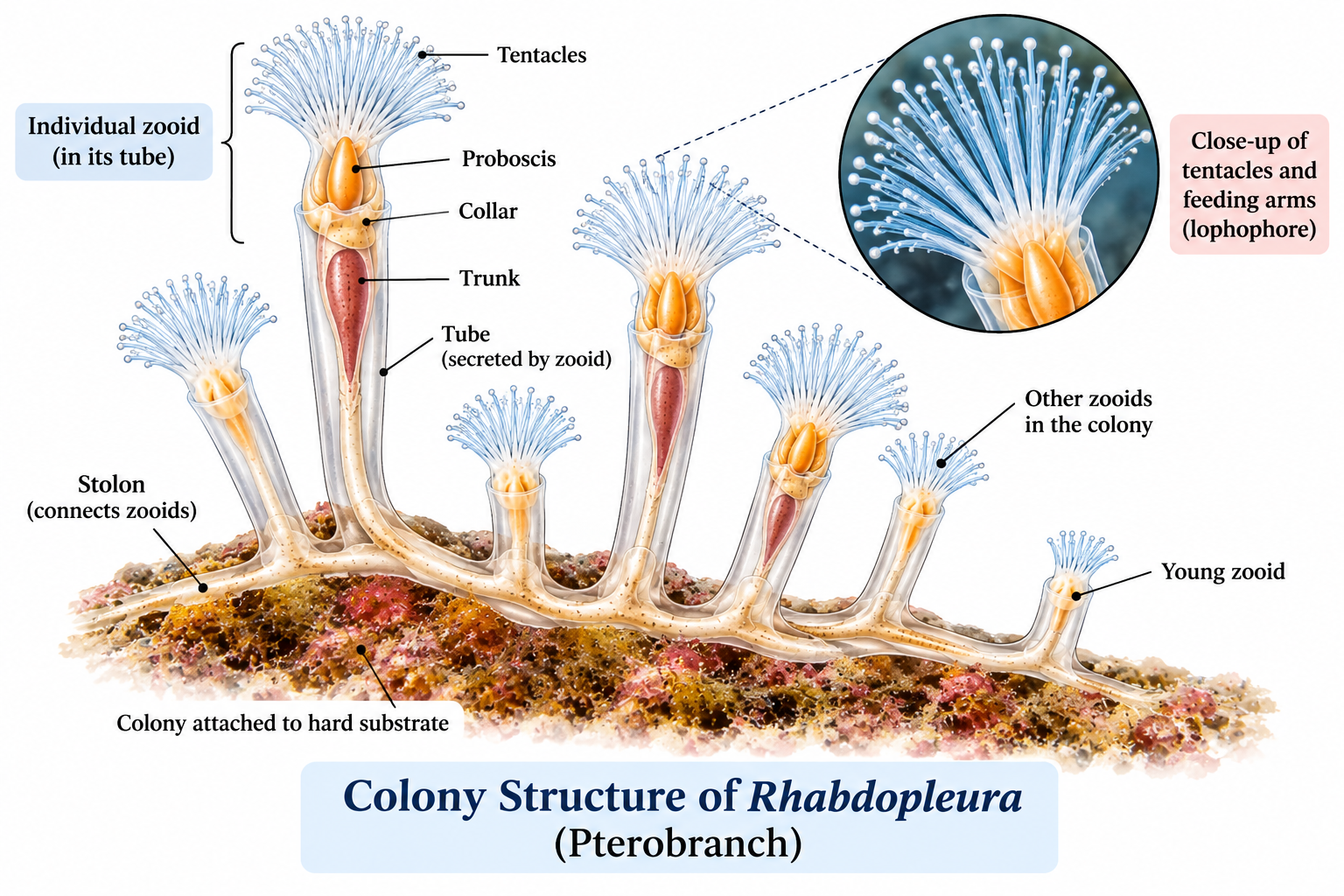
The colonial organization of Rhabdopleura is important because it provides a living example of the type of colonial organization associated with graptolites. Modern Rhabdopleura has therefore become particularly valuable for studying the biology and evolutionary history of this extinct fossil group.
Body Organization and Digestive System of Rhabdopleura
The body of Rhabdopleura is highly modified for a sessile, colonial lifestyle. Each zooid has the basic hemichordate body plan, but its organization differs considerably from that of typical enteropneusts.
The body consists of proboscis, collar and trunk. The proboscis is associated with tube secretion and attachment, while the collar bears the feeding arms and tentacles. The trunk contains most of the internal organs.
Digestive System
The digestive tract of Rhabdopleura is characteristically U-shaped. The mouth is located near the anterior feeding region, while the digestive tract curves through the body before reaching the anus.
Food captured by the tentacular feeding structures is transported toward the mouth and passes through the digestive tract, where digestion and absorption occur.
The U-shaped arrangement is an important distinguishing feature of pterobranchs and reflects their compact body organization within the colony.
Important Features
- Body divided into proboscis, collar and trunk.
- Collar bears the feeding arms and tentacles.
- Mouth is associated with the feeding region.
- Digestive tract is U-shaped.
- Anus opens near the posterior region.
- Digestive organs are contained within the compact trunk.
- The body lacks the elongated, free-burrowing organization typical of enteropneust acorn worms.
This specialized body organization allows Rhabdopleura to remain within its tube while efficiently feeding and maintaining its colonial lifestyle.
Nervous System of Rhabdopleura
The nervous system of Rhabdopleura is relatively simple and is adapted to coordinate feeding, movement of the tentacles and responses to environmental stimuli.
A dorsal nerve cord occurs in the collar region, while nerve fibres extend into different parts of the body. A network of nerves also occurs within the epidermis and helps coordinate sensory and motor activities.
Main Features
- A collar nerve cord is present.
- Nerve fibres extend toward the proboscis, collar and trunk.
- The nervous system coordinates movement of the feeding arms and tentacles.
- Sensory structures detect mechanical and environmental stimuli.
- There is no vertebrate-type brain.
- Neural control is closely associated with the zooid’s feeding and attachment activities.
The simple organization of the nervous system reflects the small body size and relatively specialized lifestyle of Rhabdopleura within its colonial tube system.
Reproduction and Development in Rhabdopleura
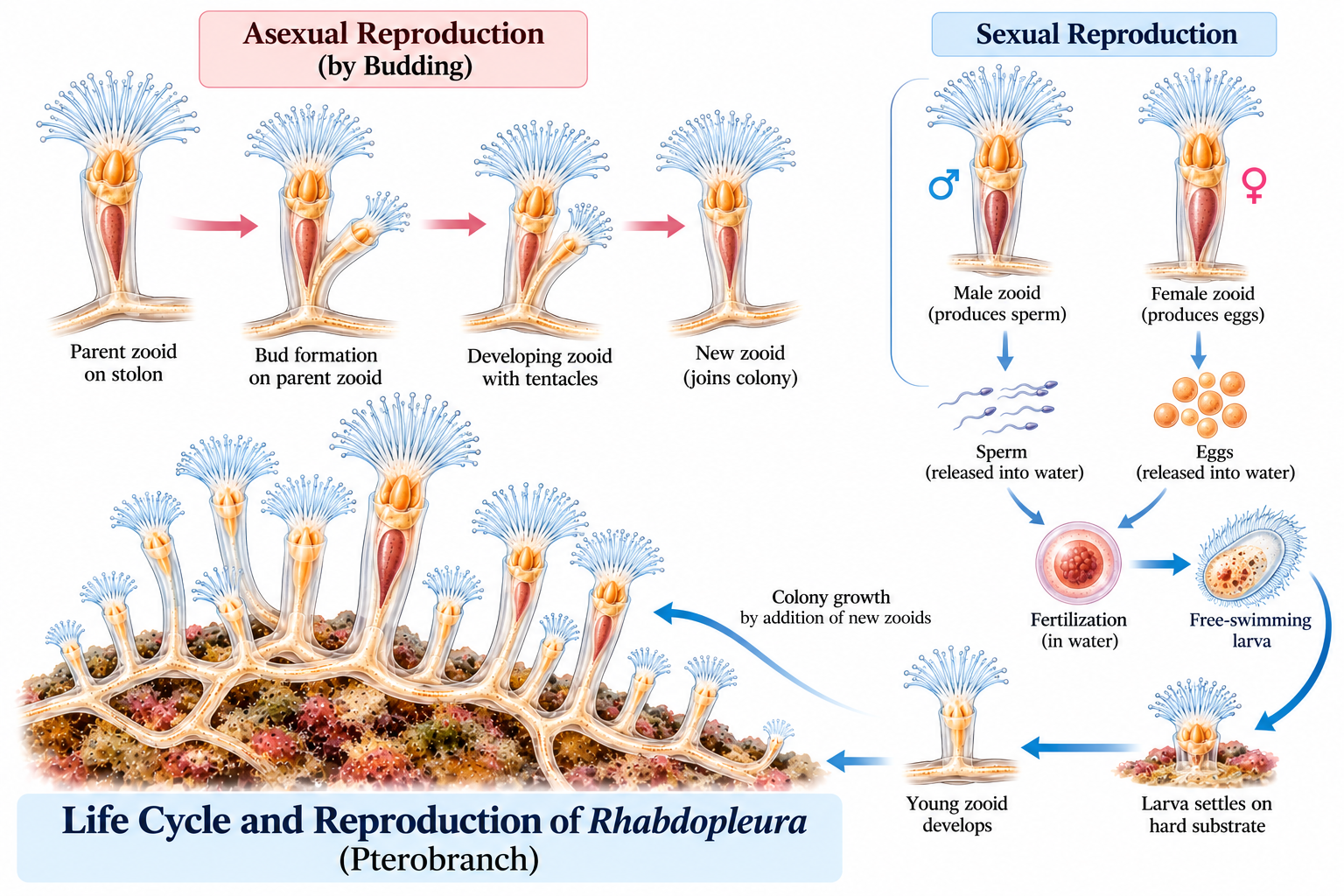
Rhabdopleura can reproduce through both asexual budding and sexual reproduction. Asexual reproduction is particularly important in colony growth because new zooids can develop from existing members of the colony.
Asexual Reproduction
During budding, a new zooid develops from an existing zooid or stolon. The developing zooid becomes incorporated into the colony and eventually develops its own feeding structures and tube.
This process allows the colony to increase in size without requiring the production and fusion of gametes.
Sexual Reproduction
Sexual reproduction involves the formation of reproductive cells and the production of embryos.
Depending on the species and developmental stage, reproductive structures may occur in association with the colony.
The developmental biology of pterobranchs is particularly important because it provides information about the relationship between living pterobranchs and fossil graptolites.
Key Points
- Both asexual budding and sexual reproduction occur.
- Budding produces additional zooids and contributes directly to colony growth.
- Sexual reproduction provides a mechanism for producing new individuals and maintaining populations.
- Developmental patterns can vary among pterobranch species.
- Reproduction and colony formation are closely linked in the life history of Rhabdopleura.
Evolutionary Significance of Rhabdopleura
Rhabdopleura is especially important in zoology because it provides a living representative of the pterobranch lineage associated with fossil graptolites.
Pterobranchs were historically difficult to relate to the fossil graptolite record because most graptolites are extinct.
Modern studies comparing morphology and molecular relationships have supported a close evolutionary relationship between Rhabdopleura and the graptolite lineage.
Why Rhabdopleura Is Important
- It belongs to Phylum Hemichordata and Class Pterobranchia.
- It provides a living example of a colonial pterobranch body plan.
- Its tube-building and colonial organization can help in interpreting fossil graptolite structures.
- Comparative studies of living Rhabdopleura and fossil graptolites contribute to understanding graptolite evolution.
- It helps illustrate the diversity of hemichordates beyond the familiar enteropneust acorn worms.
- Its evolutionary position is also relevant to understanding relationships among major deuterostome groups.
Modern phylogenetic research has described Rhabdopleura as an extant graptolite, linking this living genus with the fossil graptolite lineage. This makes it one of the most important living organisms for studying the biology and evolutionary history of graptolites.
Ecological Importance of Rhabdopleura
Rhabdopleura is a small but ecologically relevant component of marine benthic communities. Its colonies occur on suitable marine substrates, where the zooids obtain suspended organic particles from the surrounding seawater.
Ecological Roles
- Suspension feeding: Zooids remove small suspended particles from seawater while feeding.
- Food-web contribution: Rhabdopleura serves as part of marine food webs and transfers organic matter to higher trophic levels.
- Colony habitat: The tubes and colony structures provide small-scale surfaces and spaces that may interact with other organisms in the benthic environment.
- Organic matter processing: Through feeding and digestion, the colonies participate in the movement of organic material through marine ecosystems.
- Benthic biodiversity: Rhabdopleura contributes to the diversity of colonial hemichordates found in marine habitats.
Although individual zooids are very small, their colonial organization allows Rhabdopleura to form visible structures on suitable substrates and become part of complex marine communities.
Key Takeaways
- Rhabdopleura is a marine hemichordate belonging to class Pterobranchia.
- It is a colonial animal composed of small zooids.
- The zooids live within secreted tubes and are connected through a stolon system.
- Its body is organized into proboscis, collar and trunk.
- The collar bears tentacular feeding structures used for suspension feeding.
- The digestive tract is characteristically U-shaped.
- Rhabdopleura lacks pharyngeal gill slits and does not possess a true notochord.
- Colonies can grow through asexual budding, while sexual reproduction also occurs.
- Modern Rhabdopleura is important for understanding the evolution and biology of fossil graptolites.
- Its colonial, tube-dwelling lifestyle distinguishes it from the solitary acorn worms Balanoglossus and Saccoglossus.
Frequently Asked Questions
What is Rhabdopleura?
Rhabdopleura is a genus of small marine hemichordates belonging to class Pterobranchia. It is characterized by its colonial lifestyle and tube-dwelling zooids.
Is Rhabdopleura an acorn worm?
No. Rhabdopleura is a pterobranch hemichordate, whereas typical acorn worms belong to class Enteropneusta. Pterobranchs are generally colonial and live in secreted tubes.
Is Rhabdopleura colonial?
Yes. Rhabdopleura commonly forms colonies composed of numerous zooids connected through a stolon system.
Where does Rhabdopleura live?
Rhabdopleura is a marine animal. Its colonies occur on suitable substrates in different oceanic regions, with distribution varying among species.
How does Rhabdopleura obtain food?
It is adapted for suspension feeding. Its tentacular feeding structures generate water currents and capture small suspended food particles from seawater.
Does Rhabdopleura have a notochord?
No. Rhabdopleura is a hemichordate and does not possess a true chordate notochord.
How does Rhabdopleura reproduce?
VNo. Rhabdopleura is a hemichordate and does not possess a true chordate notochord.
What is the main identifying feature of Rhabdopleura?
Its combination of colonial zooids, secreted tubes, stolon connections and tentacular feeding structures is characteristic of the genus.
Recommended Study Resource
A Manual Of Practical Zoology: Invertebrates
by Verma P.S. (Author)
Practical Zoology For B.Sc.
First Year (1st & 2nd Semesters)
As an Amazon Associate I earn from qualifying purchases.
References
- Mitchell, C. E., et al. (2013). Phylogenetic analysis reveals that Rhabdopleura is an extant graptolite.
- Ruppert, E. E., Fox, R. S. & Barnes, R. D. – Invertebrate Zoology
Discover more from Zoologyverse
Subscribe to get the latest posts sent to your email.