
Wastebasket taxon (also called a waste-bin taxon, dustbin taxon or catch-all taxon) is a term used by some taxonomists to refer to a taxon intended to classify organisms that do not fit anywhere else. They are generally defined by designated members, often superficial resemblance to each other, lack of one or more distinct trait states, or non-membership of one or more other taxa. Wastebasket taxa are by definition either paraphyletic or polyphyletic and therefore are not considered valid taxa according to the strict branching rules of taxonomy. However, the names of Wastebasket taxa are sometimes retained as designations of evolutionary class.
Examples of Wastebasket taxon
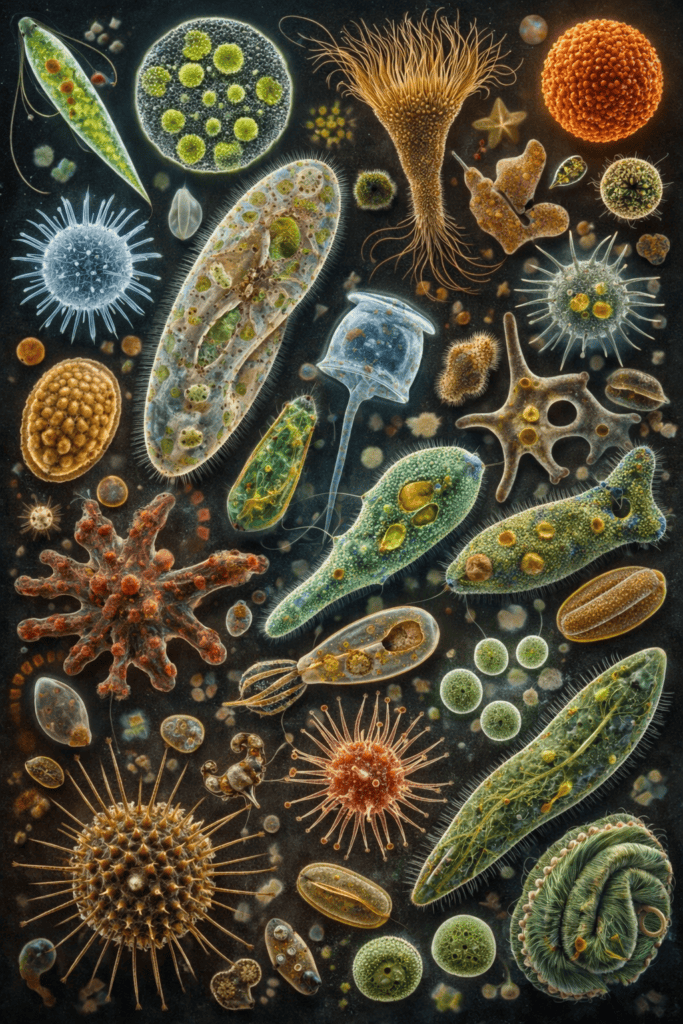
Although there are many examples of paraphyletic groups, the true Wastebasket taxon are those that are not known or may not be intended to represent natural groups, yet are used as actual biological groups. Kingdom Protista is probably the best known example. Wastebasket taxa are often ancient (and perhaps not described with as much systematic rigor and precision as possible, given the knowledge of accumulated diversity) and large populations.
- Flacoutiaceae, a now extinct family of flowering plants – The Angiosperm Systematic Group classifies the tribe and genus into various other families, such as Acridaceae and Salicaceae. The obsolete kingdom Protista includes all non-animal, plant, and fungal eukaryotes, and protozoa includes all unicellular eukaryotes.
- Tricholomatidae is a group of fungi that was once comprised of the genus Agaricaceae with white, yellow, or pink spores, but has not yet been classified as belonging to the Amanitaidae, Lepidoptera, Hygrophoraceae, Amanitainae, or Insectainae family.
- Carnosauria and Thecodontia are a group of fossils that came together when the limited fossil record failed to create a more detailed picture.
- Condylarthora is an artificial clade in which ungulate mammals that do not clearly belong to the Order Perissodactyla or the Order Paleodactyla have traditionally been placed. Although many of these groups, such as Meridiungulata and Protungulatum, may not represent Lauracitherian mammals, others, such as the Phenacodontidae, have been clearly identified as early equine ungulates.
- The order Insecta is traditionally used as a dumping ground for placental insectivorous mammals (and similar forms such as corgos), usually along with carnivores, ungulates, and bats. The core members (moles, shrews, hedgehogs, and their relatives) actually form a coherent clade, Eurypotyphra, which is part of Laurasiatheria with the aforementioned clades, but other mammals historically classified in this order belong to other branches of the placental tree. Shrews and colgos are euarchontans related to primates and are sometimes grouped with Sundateria, whereas tenrecs, golden moles, and elephant shrews are all African animals, probably forming the African entomophile clade. These two clades group superficially similar animals in the genera Euarchonta and Afrotheria, respectively, and are themselves sometimes accused of being garbage taxa, but are more strongly supported by genetic studies.
- Vermes are an obsolete taxon of insect-like animals. This was a general term used by Carl Linnaeus and Jean-Baptiste Lamarck to refer to invertebrates that are not arthropods.
- The genus Mamenchisaurus is sometimes considered a garbage taxon of large, long-necked dinosaurs.
Paleontology
Fossil groups that are poorly known due to fragmentary remains are sometimes grouped together based on common morphology or stratigraphy, and are only later discovered to be Wastebasket taxa, such as the Triassic crocodile-like group Lauisuria.
One of the tasks of taxonomists is to identify trash taxa and reclassify their contents into more natural units. In some cases, during taxonomy revisions, a taxon can be rescued from the trash after careful examination of its members and stricter restrictions on what it continues to include. Such techniques “saved” carnosaurs and megalosaurs. In other cases, the taxonomic name contains too much unrelated “baggage” to be successfully retrieved. As such, it is usually dumped in favour of a new, more restrictive name (for example, Rhynchocephalia), or abandoned altogether (for example, Simia).
Related concepts
A related concept is taxonomic form, or Wastebasket taxon groups joined by a common morphology. This is often the result of a common, often universal, lifestyle, resulting in nearly similar body forms through convergent evolution.
The term “trash taxon” is sometimes used in a pejorative manner to refer to evolutionary-level taxa.
See other post also
Discover more from Zoologyverse
Subscribe to get the latest posts sent to your email.