
Introduction
Sepia is a remarkable genus of cuttlefish recognized for its advanced camouflage abilities, intelligence, and unique cuttlebone structure. This guide provides a clear overview of its classification, physical traits, ecology, and importance in marine ecosystems.

Scientific Classification of Sepia
| Taxonomic Rank | Classification | Characteristics |
|---|---|---|
| Kingdom | Animalia | Multicellular and heterotrophic |
| Phylum | Mollusca | Soft-bodied invertebrates |
| Class | Cephalopoda | Intelligent animals with tentacles |
| Order | Sepiida | Includes true cuttlefish |
| Family | Sepiidae | Possess distinctive cuttlebones |
| Genus | Sepia | Known for camouflage and predation |
Understanding the Name Sepia
The name Sepia comes from Greek and refers to the cuttlefish itself. Historically, the well-known sepia-brown ink used in art and writing was produced from cuttlefish ink sacs. This connection makes the term “sepia” both a biological and artistic reference.
Physical Characteristics of Sepia
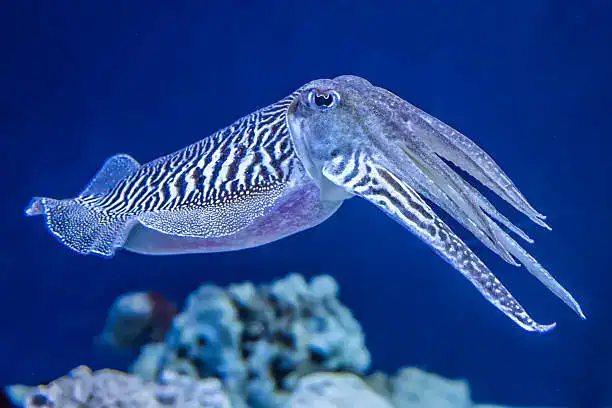
Species have a broad, oval body supported by a lightweight cuttlebone that provides buoyancy. Their large eyes—with distinctive W-shaped pupils—allow excellent depth perception. Additionally, their skin contains specialized pigment cells that enable instant color and texture changes. This camouflage system is essential for both communication and survival.
Habitat and Distribution
Members of the genus Sepia live in warm and temperate oceans around the world. They thrive in shallow coastal waters, coral reefs, seagrass beds, and sandy sea floors. Some species migrate to deeper waters, especially during breeding seasons.
Characterstics of Sepia
- Commonly called as cuttle-fish.
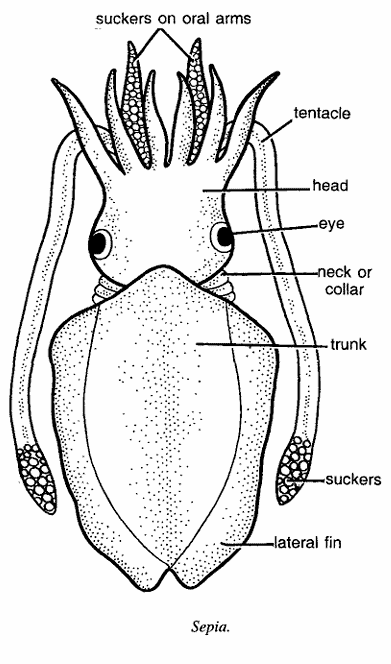
- Body is fleshy and differentiated into anterior head, middle collar and posterior trunk or visceral hump.
- Colour is brownish with white spots stripes with violet fins.
- Chromatophores are present in the deeper layers of integument hence it gives a pigmented appearance.
- Head contains 10 oral arms. 8 oral arms are smaller and have several rows of pedicellate suckers ventrally encircling around mouth.
- 2 arms on each side are elongated, each having several pedicellate suckers at its tip and are called as hectocotylised arms for capture of prey.
- At the base of head is a pair of eyes without olfactory crest.
- Sepia is luminescent and dibranchiate. It is also a myopsidan mollusc, having imperforated cornea and single oviduct.
- The internal chambered calcareous shell is well developed and flat, and the animal uses this shell to maintain neutral buoyancy.
- Chromatophores are present in the deeper layers of the integument and hence it gives a pigmented appearance.
- Sexes are separate.
Behavior and Lifestyle
Cuttlefish within the genus Sepia display highly developed behaviors. They typically move using gentle fin undulations, but they rely on rapid jet propulsion when escaping predators. Their feeding behavior is equally impressive: they capture prey such as small fish and crustaceans by extending specialized tentacles. Moreover, they protect themselves using ink release and quick camouflage shifts.
Life Cycle and Reproduction
During breeding seasons, Sepia species migrate to shallow waters. Females lay clusters of eggs on seaweed, rocks, or shells. The hatchlings resemble miniature adults and begin hunting independently almost immediately, which helps ensure their survival.
Notable Sepia Species
- S. officinalis – Common cuttlefish
- S. apama – Giant Australian cuttlefish
- S. latimanus – Broadclub cuttlefish
- S. pharaonis – Pharaoh cuttlefish
Ecological Importance
Cuttlefish of the genus play a crucial ecological role. As mid-level predators, they help balance populations of smaller marine animals. They are also prey for dolphins, sharks, and large fish. Additionally, pet owners widely use their cuttlebones as calcium supplements for birds, and these cuttlebones also support nutrient cycles along shorelines.
Interesting Facts About Sepia
- Animal ejects ink by its ink gland in sea water when irritated. Ink is secreted from a pear-shaped ink sac lying over postero-ventral surface. Ink is called as Sepia ink which acts as defense mechanism for enemies.
- They can change color faster than the blink of an eye.
- Their intelligence rivals many vertebrates.
- The historical sepia ink pigment originates from their ink.
- Though often called “fish,” they are actually mollusks.
References
- Marine Biological Association – https://www.marlin.ac.uk/species/detail/1098
- Animal Diversity Web – https://animaldiversity.org/accounts/Sepia_officinalis/
- Encyclopedia of Life – https://eol.org/pages/51444
- FAO Cephalopod Catalogue – https://www.fao.org/3/i3489e/i3489e.pdf
- Biology Discussion – https://www.biologydiscussion.com/mollusca/sepia-anatomy-and-classification/31811
- Smithsonian Ocean – https://ocean.si.edu/ocean-life/invertebrates/cuttlefish
Discover more from Zoologyverse
Subscribe to get the latest posts sent to your email.