
Cephalodiscus is a small genus of sessile hemichordates belonging to the class Pterobranchia. These colonial, tube-dwelling marine organisms are known for their unique lifestyle, in which individuals live within secreted tubular structures attached to rocky or deep-sea substrates. Each zooid possesses a set of feathery arms used for filter feeding. Although they are relatively simple in structure, species of Cephalodiscus provide valuable insight into early deuterostome evolution and the origin of chordate characteristics.
Classification of Cephalodiscus
- Phylum :- Hemichordata (Marine, enterocoelous coelomate. Notochord confined to head region)
- Class :- Pterobranchia (Small hemichordates with encased body. V-shaped intestine.)
- Order :- Cephalodiscida (Solitary or colonial, 2 gill slits, 2 gonads.)
- Genus :- Cephalodiscus

Geographical distribution of Cephalodiscus
- Cephalodiscus lives in the Antarctic and sub-Antarctic regions and occupies archibenthal and sub-littoral zones. Researchers have reported it from India, Japan, Sweden, Borneo, Malaysia, the Malay Archipelago, and the Pacific Ocean.
Habit and Habitat
It is a marine colonial animal, found at a depth of 50 to 60 meters. The animal was first discovered by Challanger (1876) at a depth of approximately 245 fathoms in Magellan Strait. Antarctic and Indian oceans have abundant number of this animal.
Characteristics of Cephalodiscus
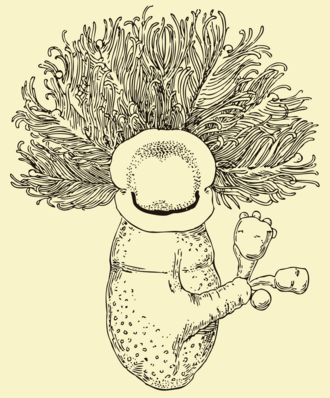
- Colony of Cephalodiscus is composed of several unconnected animals, or zooids, which are enclosed in a common case known as coenoecium.
- Zooids have no organic connections with each other, but they can move freely in the chambers.
- Zooids are microscopic and differentiated into protosome or cephalic shield, mesosome or collar and trunk.
- Protosome or proboscis is flexible and contains heart, buccal diverticulum and the central sinus.
- The shield-shaped protosome connects directly to the collar, which bears two groups of bilaterally arranged arms containing tentacles.
- The trunk consists of an anterior sacciform region that contains the alimentary and genital organs, and a posterior slender stalk that serves as an adhesive structure.
- Anus is present ventrally.
- Digestive tube is V-shaped. Breeding seasonal, sexes are separate.
- A sexual reproduction takes place by the budding of the stolon.
- New individuals detach for free existence but maintaining colonial relationship.


Special features
Zooids or individuals separate but aggregated into a common housing
Identification
Since the specimen has coenoecium and all above features, hence it is Cephalodiscus
Discover more from Zoologyverse
Subscribe to get the latest posts sent to your email.
Couldn’t be more grateful! 💕
Thanks a lot…|