
The history of biological classification states that the Greek philosopher Aristotle categorized many creatures according to their environment, traits, etc. Later, in the 18th century, Swedish botanist Carolus Linnaeus established the Taxonomic Hierarchy Categories, a classification scheme that is still in use today.
The arrangement of categories in either ascending or descending order is referred to as the taxonomic hierarchy. In the hierarchy, species is at the bottom and kingdom is at the top.
Let’s examine the Taxonomic Hierarchy in Biological Classification in more detail.
Define Taxonomic Hierarchy?
The Greek words “taxis,” which means arrangement or division, and “nomos,” which means method, are the roots of the English term “taxonomy.”
The process of categorizing various living organisms is known as taxonomy, and it is a field within biology. A group of creatures categorized as a single entity is called a taxon.
The process of placing different creatures into progressively higher or lower levels of the biological taxonomy, either in ascending or descending order, from kingdom to species and vice versa, is known as taxonomic hierarchy.
The taxonomic category or rank refers to each of these tiers of the hierarchy.
Kingdom is always at the top of this classification scheme, followed by division, class, order, family, genus, and species.
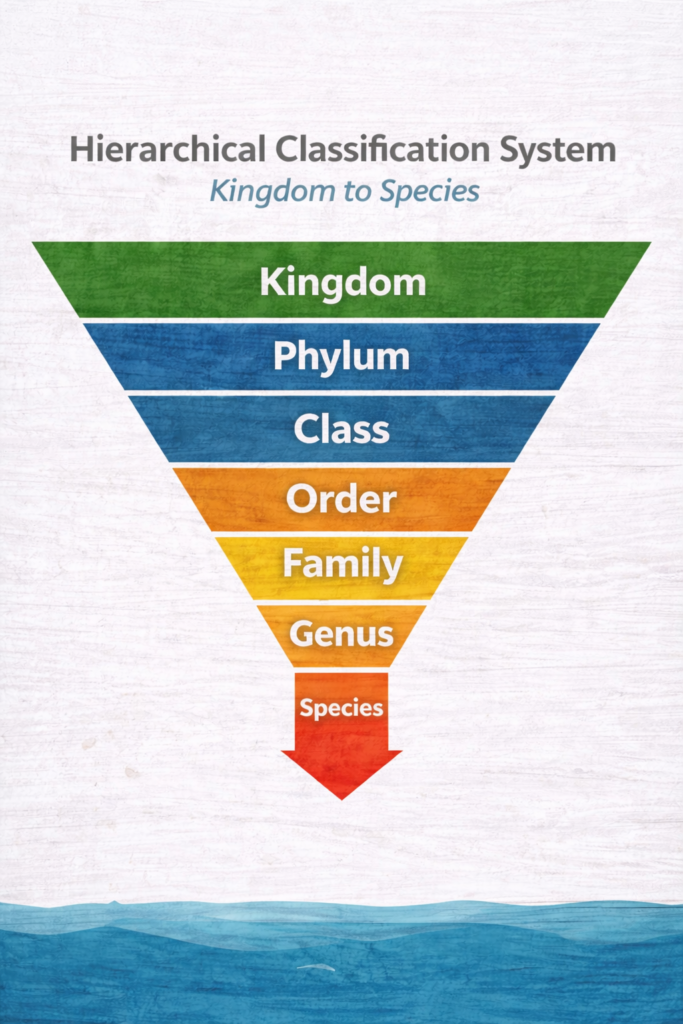
Categories of the Taxonomic Hierarchy
The significant taxonomic hierarchies that are used to classify various creatures are as follows:
The Kingdom
The highest level of classification is the kingdom, which is then subdivided into many levels of subgroups. Animalia, Plantae, Fungi, Protista, and Monera are the five kingdoms into which living things are divided.
Phylum
Compared to the kingdom, this level of classification is more detailed. The kingdom Animalia contains 35 phyla. For instance, Arthropoda, Chordata, Porifera, etc.
Class
Prior to the introduction of phyla, class was the most broad rank in the taxonomic hierarchy. There are 108 classes in Kingdom Animalia, such as mammalia, reptilia, aves, and others. The classes that are currently in use, however, differ from those Linnaeus suggested and are not commonly utilized.
Order
Compared to class, order is a more defined rank. The order is made up of one or more families that are comparable. The class Mammalia includes about 26 orders, including carnivora and primates.
Family
Several genera that have some similarities are included in this taxonomic hierarchy group. For instance, the Canidae, Felidae, Ursidae, and other families are members of the order Carnivora.
Genus
A genus is a collection of related species. Some genera are monotypic, meaning they only have one species, while others are polytypic, meaning they have multiple species. For instance, the genus Panthera includes tigers and lions.
Species
In the taxonomic hierarchy, it is the lowest level. On Earth, there are roughly 8.7 million distinct species. It describes a collection of organisms with comparable forms, shapes, and reproductive characteristics. Subspecies are a further division of a species.
Here is a clear table showing an example of a taxonomic hierarchy (using the human species as an example):
| Rank | Taxonomic Category | Example (Human) |
|---|---|---|
| Domain | Eukarya | Organisms with true nucleus |
| Kingdom | Animalia | Multicellular animals |
| Phylum | Chordata | Animals with a notochord |
| Class | Mammalia | Mammals |
| Order | Primates | Primates |
| Family | Hominidae | Great apes |
| Genus | Homo | Human genus |
| Species | Homo sapiens | Modern humans |
See other Posts also
- What Are Mammals? Definition, Characteristics
- Introduction to Aves (Birds)
- Reptiles | Definition, Characteristics, Examples, & Facts
- Amphibians | Characteristics, Life Cycle, & Facts
- Pisces : Definition, Classification and Characteristics
Discover more from Zoologyverse
Subscribe to get the latest posts sent to your email.